
Title: Cloud Does Not Automatically Mean Better Author: Nick Gates Date: August 10, 2026 Category: IT Strategy / Cloud

At some point, “move it to the cloud” became the answer to nearly every technology question. Old server? Move it to the cloud. Employees need remote access? Move it to the cloud. Software causing problems? Move it to the cloud.
Cloud technology has created some incredible opportunities. It has made it easier for employees to work from different locations, collaborate with one another, and access information without being tied to one physical office.
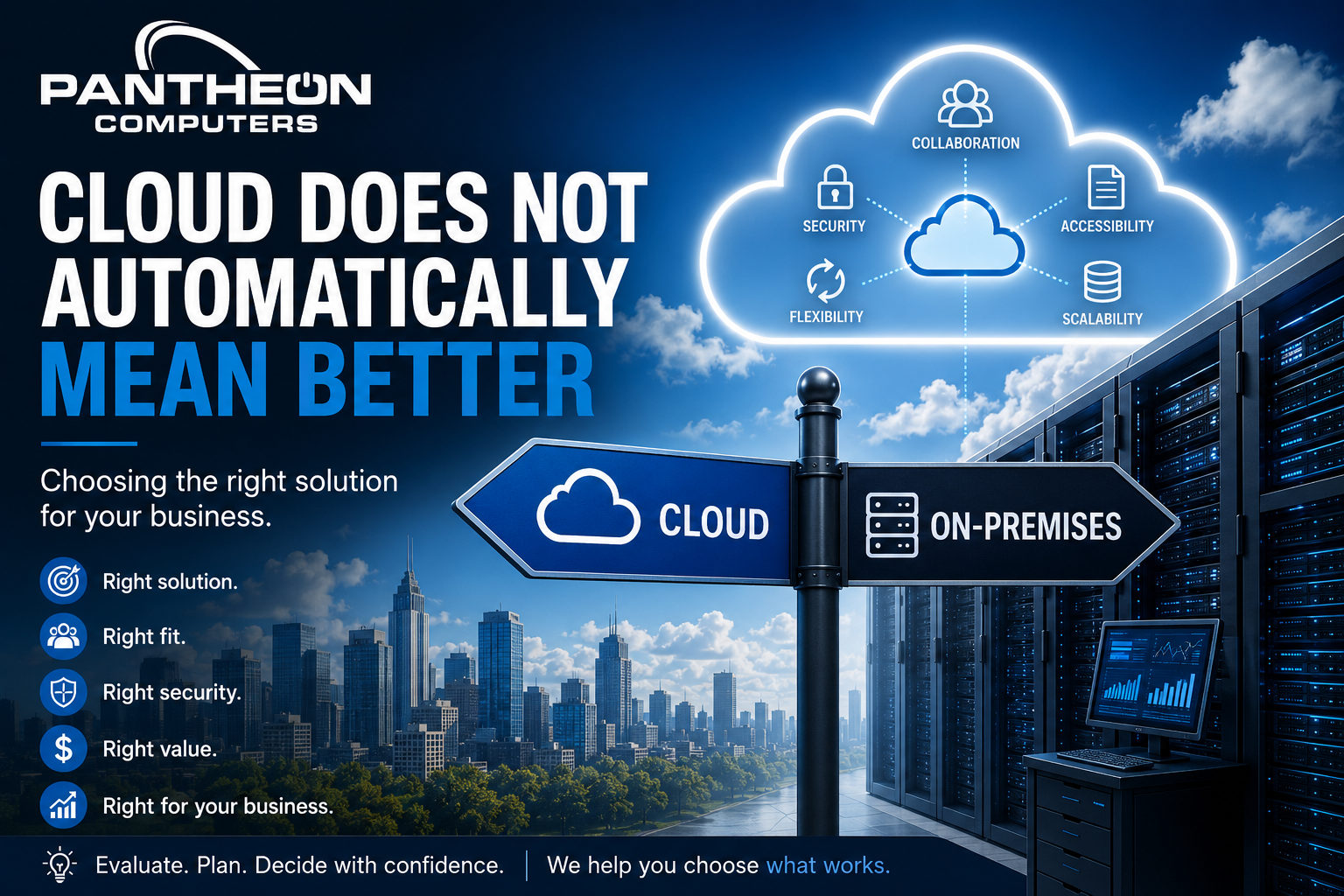
But cloud does not automatically mean better. It also does not automatically mean cheaper, faster, safer, or easier. It depends on the business.
The Right Question to Ask
A few years ago, many companies treated the cloud as a destination. The goal was simply to get there. Today, the more useful question is: Does moving this particular system to the cloud make sense for this particular organization?
Sometimes the answer is absolutely yes. A cloud-based application may reduce the need to maintain a server. It may improve remote access, make updates easier, and give employees more flexibility. It may also provide better redundancy than a small business could reasonably build on its own.
Other times, the answer is no. A business may have a large amount of data that would be expensive to store in the cloud. Its employees may work with files that need to open quickly on the local network. Its internet connection may not be reliable enough to support a fully cloud-based operation. There may also be specialized equipment or software that was designed to run locally.
In those situations, moving to the cloud simply because it sounds more modern can create more problems than it solves.
“Keeping everything on a server in the office because ‘that is how we have always done it’ is not a strategy either.”
Neither Option Is Free. Neither Is Perfect.
On-premises systems require maintenance, replacement planning, backups, security, and power protection. Someone must be responsible for keeping them healthy. Neither option is free. Neither option is perfect. And neither option is automatically right.
The best environments are often a mix of both. Email and collaboration may live in Microsoft 365. A specialized application may remain on a local server. Backups may be stored in multiple locations. Employees may use cloud services for some tasks while accessing local systems for others.
That is not indecision. It is choosing the right tool for each part of the business.
The Cloud Is Not Magic
The cloud is not a magic place where technology problems disappear. Servers still exist. Software still needs updates. Accounts still need to be secured. Data still needs to be backed up. The equipment is simply running somewhere else.
When evaluating a cloud solution, the conversation should not begin with whether the cloud is good or bad. It should begin with what the business is trying to accomplish.
- Will it make employees more productive?
- Will it improve reliability?
- Will it reduce risk?
- What will it cost over time?
- What happens if the internet goes down?
- How difficult will it be to move the data again someday?
Those questions are less exciting than saying everything is moving to the cloud. But they lead to better decisions.
“The goal is not to choose the newest option. The goal is to choose the option that works.”