
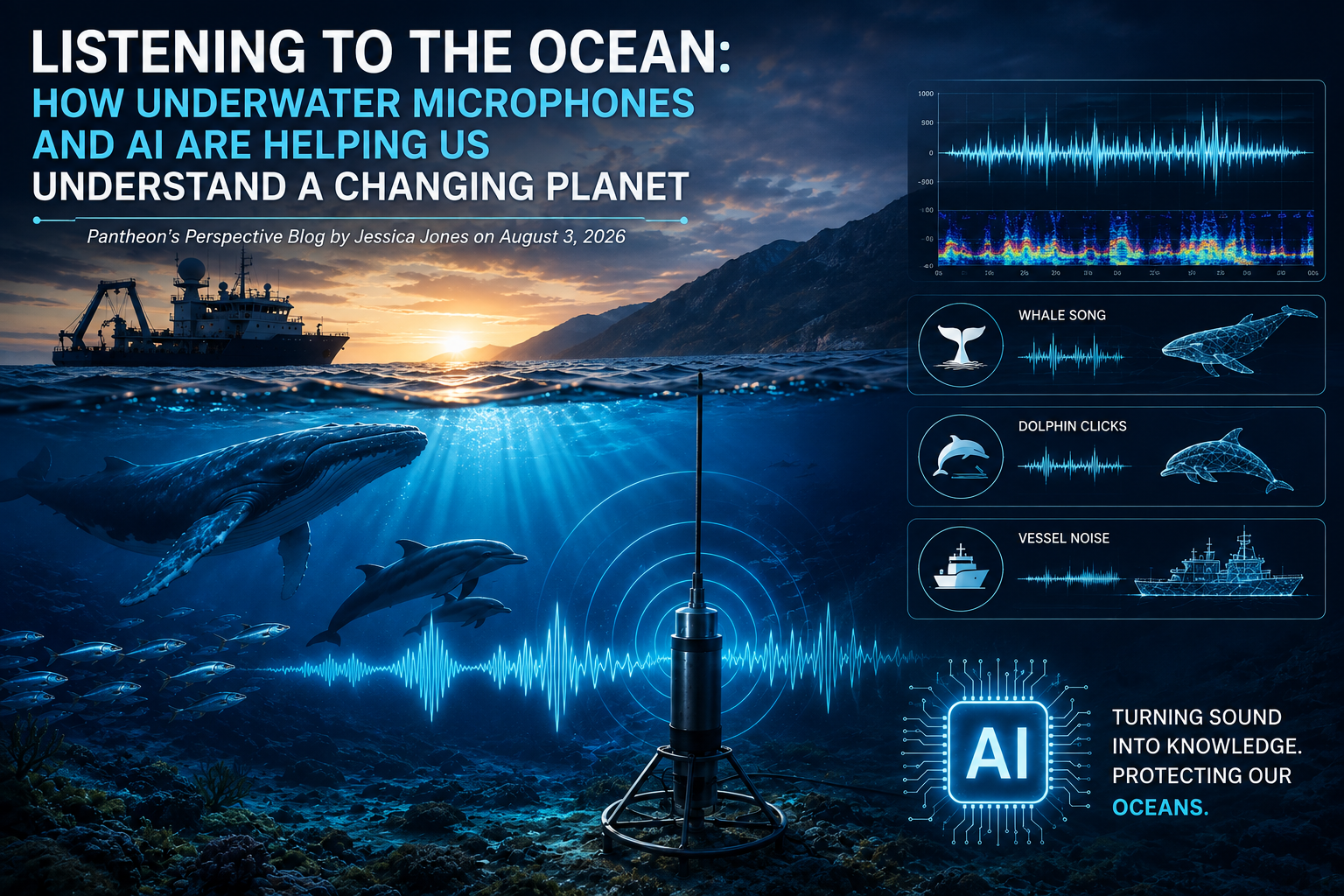
Title: Listening to the Ocean: How Underwater Microphones and AI Are Helping Us Understand a Changing Planet Author: Jessica Jones Date: August 3, 2026 Category: AI / Nature & Environment
The ocean has always been full of sound.
Long before satellites, sensors, and artificial intelligence, the sea was already speaking through whale songs, dolphin clicks, shifting currents, cracking ice, rumbling earthquakes, snapping shrimp, and the low hum of distant ships. To the human ear, much of that world is hidden. Beneath the surface, visibility fades quickly. Light disappears. Distance becomes difficult to measure. But sound travels far.
That is why scientists are learning to listen.
Today, underwater microphones called hydrophones are helping researchers monitor marine life and ocean conditions in ways that were once impossible. These devices can sit quietly beneath the waves for days, months, or even years, recording the sounds of whales, dolphins, fish, vessels, storms, and geological activity. NOAA Fisheries describes passive acoustic monitoring as a way to record underwater sound across time and space, from a few kilometers to ocean-wide listening networks.
When paired with artificial intelligence, those recordings become even more powerful. AI can help sort through massive amounts of sound data, recognize patterns, detect animal calls, identify unusual changes, and alert researchers to activity they might otherwise miss. In a world where the ocean is changing rapidly, listening is becoming one of our most important tools for understanding what is happening below the surface.
Hearing What We Cannot See
The ocean is difficult to study because it is vast, deep, dark, and constantly moving. A researcher may spend weeks at sea and still only observe a tiny fraction of what is happening. Hydrophones help extend human presence into places we cannot easily reach. Instead of relying only on visual surveys, scientists can place listening devices in important habitats, migration routes, remote waters, and protected areas. These instruments capture sound continuously, creating an acoustic record of ocean life. NOAA Fisheries uses passive acoustic monitoring to study marine mammals because many species rely on sound to navigate, socialize, find food, avoid predators, and communicate.
For whales and dolphins, this is especially important. Many species are highly vocal. Whales sing, pulse, moan, and call across long distances. Dolphins use clicks and whistles to communicate and navigate. By listening for these sounds, researchers can better understand where animals are, when they are present, how they move, and how their behavior changes over time.
This kind of monitoring can reveal patterns that might not be obvious from a boat or aircraft. A whale species may return to an area earlier than expected. Dolphins may shift their range. A quiet habitat may suddenly become noisy with ship traffic. A once-active reef may begin to sound less alive. Each sound becomes a clue.
AI as the Ocean’s Translator
The challenge is not collecting sound. The challenge is making sense of it. A single hydrophone can record thousands of hours of audio. A network of hydrophones can generate more data than humans could ever review manually. That is where AI becomes valuable.
Machine learning systems can be trained to recognize specific whale calls, dolphin clicks, ship noise, or other acoustic signatures. Instead of asking researchers to listen to endless recordings by hand, AI can scan the data, flag meaningful events, and help classify sounds more quickly.
For example, conservation projects such as AI for Orcas are using hydrophone networks and machine learning models to detect killer whale calls, clicks, and whistles in near real time. That kind of information can help researchers understand where whales are moving and may eventually support better decisions around vessel traffic, habitat protection, and conservation response.
“AI does not replace scientists. It helps them focus. It turns overwhelming amounts of raw audio into patterns humans can interpret. The technology listens constantly, but people still provide the context, judgment, and ethical decision-making.”
Tracking Whales, Dolphins, and Sharks
For whales and dolphins, underwater listening can help answer essential conservation questions. Which species are present? Are they migrating earlier or later? Are they avoiding noisy areas? Are they using protected habitats as expected? NOAA notes that passive acoustic monitoring can help detect and classify marine mammal calls by species and analyze whether a species is common or rare at a recording site.
Sharks are monitored a little differently. Most sharks do not sing like whales or communicate like dolphins in ways that hydrophones can easily detect. Instead, researchers often use acoustic telemetry. A shark is fitted with a small acoustic tag that sends out a coded signal, and underwater receivers detect the signal when the shark swims nearby. NOAA Fisheries describes passive acoustic tracking as an important tool for studying shark and sawfish movement, habitat use, migration patterns, and survivorship.
AI can then help analyze movement data, identify patterns, and improve predictions. Where do sharks spend time? Which habitats support young sharks? How do water temperature, food availability, or human activity influence their movement? These are not just scientific questions. They help communities understand marine ecosystems more clearly and make better decisions about conservation, fisheries, and coastal management.
Listening for Earthquakes and a Changing Seafloor
The ocean does not only carry the sounds of animals. It also carries the sounds of the Earth itself.
Underwater microphones and related sensing technologies can detect seismic activity, volcanic activity, and sound waves moving through the ocean. Woods Hole Oceanographic Institution explains that hydrophones can record whale calls as well as sound waves used to examine structures on and below the seafloor.
More recently, researchers have explored how fiber-optic cables on the seafloor can act like dense listening systems. A 2026 deep learning study using distributed acoustic sensing showed that AI could help detect and classify marine acoustic and seismic events, including local earthquakes, whale calls, and vessel traffic.
This matters because the seafloor is active. Earthquakes, volcanic eruptions, underwater landslides, and shifting plates all shape the planet. Better listening systems can help researchers monitor hazards, understand geological processes, and collect data from regions where traditional instruments are sparse.
The Sound of an Ecosystem
Every ecosystem has a soundscape.
A healthy reef may crackle with shrimp, fish calls, and the movement of marine life. A busy shipping lane may be filled with engines. A changing Arctic may carry the sounds of melting ice, shifting species, and new human activity. By listening over time, scientists can detect changes in the acoustic character of an environment.
NOAA’s Passive Acoustic Data Viewer describes passive acoustic monitoring as a tool for detecting and characterizing sounds from fish and marine mammals, physical oceanographic processes, and human-made noise sources that contribute to the overall ocean noise environment.
That means sound can become an indicator of ecosystem health. If certain biological sounds decline, it may suggest a shift in species presence or abundance. If human noise increases, it may affect animals that depend on sound to survive. If storm patterns, ice movement, or reef activity change, the acoustic record may help reveal those changes.
AI can help connect these dots. It can compare recordings across seasons, locations, and years. It can identify anomalies. It can help researchers notice when an ecosystem sounds different than it used to.
Technology That Supports Stewardship
The most meaningful part of this work is not the technology itself. It is what the technology allows us to protect.
Hydrophones and AI give us a new way to pay attention. They help us notice whales moving through busy waters, dolphins communicating in complex soundscapes, sharks using critical habitats, earthquakes rumbling beneath the seafloor, and ecosystems shifting under pressure from climate change, noise, fishing, shipping, and development.
But listening also comes with responsibility.
The goal is not to turn the ocean into another stream of data to be consumed and forgotten. The goal is to understand it more deeply. Technology should help us become better stewards, not distant observers. AI can process the signals, but humans must decide how to respond.
“The ocean has been speaking all along. For most of history, we simply did not have the tools to hear it clearly. Now we do.”
And if we listen carefully, we may learn not only how marine life is changing, but how our own choices are echoing beneath the waves.