

Title: Stop Adding Tools. Start Fixing Flow. Author: Reyna Monson, President Date: June 2, 2026 Category: Operations / IT Strategy
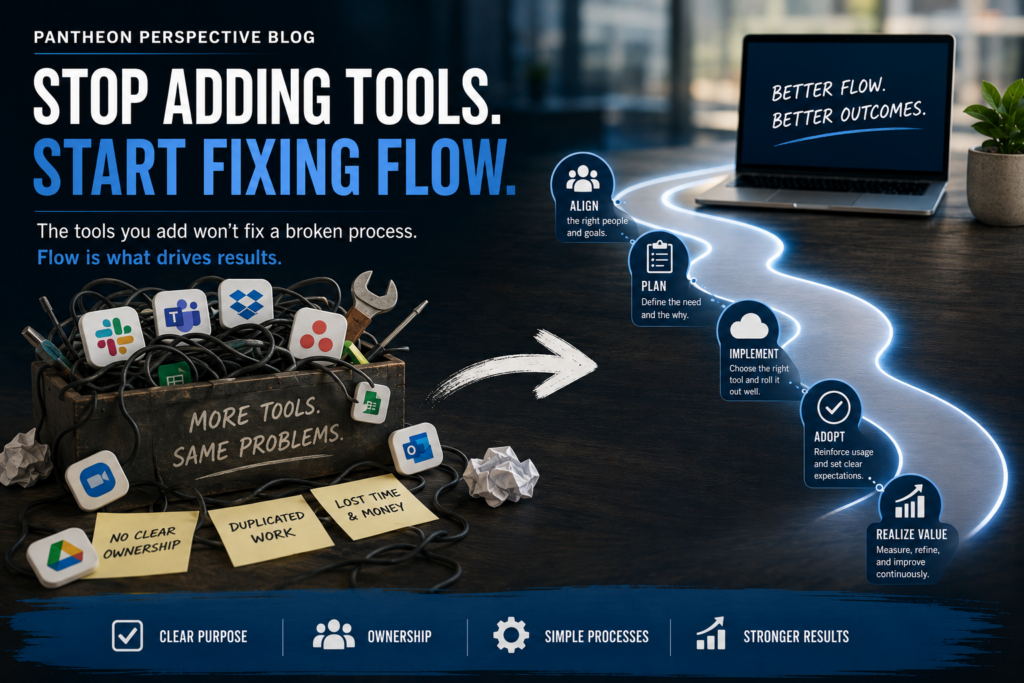
A team starts missing deadlines. Communication feels scattered, and work begins slipping through the cracks. So the company does what most companies do — they add a new tool. At first, it helps. There’s momentum, people feel more organized, and it looks like progress. But within a few weeks, the same problems resurface. Deadlines slip again. Communication breaks down again.
Because the issue was never the tools. It was the flow.
Most teams don’t have a capability problem — they have a coordination problem. Flow is how work actually moves from idea to execution to completion. When that flow is unclear or inconsistent, work slows down, gets duplicated, or stalls entirely. Adding another platform doesn’t fix that. It just gives the same broken process a new place to live.
If you look closely, the breakdowns are usually predictable. Ownership isn’t clear, so work drifts. Tasks move through too many hands and lose context along the way. Work starts before there’s real alignment, and bottlenecks quietly form around one person or one step. None of this is a software issue. It’s a workflow issue.
We see this play out all the time. One client wanted employees to access files from anywhere, so they rolled out Dropbox. It solved the immediate problem — but introduced new ones. Files were now split across systems, permissions became harder to manage, and people weren’t always sure where the “real” version lived.
The catch? They already had OneDrive. It was more secure, already included in their environment, integrated directly into File Explorer, and worked seamlessly with the rest of their Microsoft tools. They didn’t need something new — they needed to use what they had more effectively. Instead, they added complexity, and the flow of work became harder, not easier.
That’s the pattern: underused tools combined with new tools create fragmented work.
Before introducing anything new, step back and look at how work actually moves. Where does it slow down or get stuck? Who owns each step? Where is work being duplicated or restarted? How many tools are involved in a single workflow? Simplifying that path will do more for performance than any new platform.
Adding tools feels like progress. Fixing flow is progress. Most teams don’t need more software — they need clearer ownership, simpler processes, and better use of what they already have. Start there. Then decide if you need anything more.